Saturday, 10 March 2018

White sand and beaches

Being a nature lover, I am always attracted to less crowded & isolated places. I get a great amount of peace and stress relief from places which are far away from human civilization. Planning for a short trip begins once you see those red marked dates on the calendar. And if it’s a long weekend, trip to banta hai.

Maha coastline somewhere near Ratnagiri
Maharashtra is blessed with a 700 km long coast line stretching from Dahanu in the north upto Vengurla in the south. Magic unfolds when the white sand, powerful waves, gushing wind and setting sun add a flavour to the landscape. To experience this, one must travel.

A couple of years back, very few would have known about a coastal village called Tarkarli situated in Southern Maharashtra. Apart from its white beaches and Malvan fort, this place is known for its corals and fishes that rest on the shallow ocean floor. It is an ideal destination for a short budget trip. One can reach Tarkarli by rail/road. The nearest railway station is Kudal. From Kudal there are state transport buses to Malvan. Tarkarli is barely 6 kms from here. Having said that, I and my friend booked ourselves on 22115 Dn LTT-Karmali AC express leaving at 01.10 am from Lokmanya Tilak Terminus. Travelling on Konkan Railway is always a pleasurable experience. It is fun to stand at the door while the train passes through tunnels, bridges and small country side stations at high speed. Majority of the crowd in our train was bound for Goa, Tarkarli and Ratnagiri. We reached Kudal at 10.00 am the next morning. Kudal bus stand is 10-12 min walk from the railway station. Auto walas charge Rs.20 per seat. We had breakfast near the bus stand and waited for the state transport bus to Malvan. Buses are available at a frequency of 30-45 min from Kudal depot. One can also take direct auto to Tarkarli which costs around Rs.600. But being a budget traveller, we chose the first option. Kudal to Malvan is about 30 km which takes around 1 hour owing to brilliant quality roads. As we reached Malvan, there was a shuttle service to Tarkarli awaiting departure. We quickly boarded  it and were outside our hotel in next 15 minutes.

Our home stay 'Tanmay Nyahari Niwas'

We had pre booked this place called ‘Tanmay Nyahari Niwas’. It is a home stay at Wairy bhutnath, a kilometre before Tarkarli. The place is pretty decent with 3 double bed rooms and clean wash rooms. A beach access is available at the property. The best part I liked about this place was it had hammocks and sand on the porch area. Relaxing on the hammock with a beer under the shade of huge palm trees sums up the entire experience of a coastal trip.

Porch area
Our hosts stayed in the house right next to our rooms. A warm friendly couple, they asked if we would be having lunch. We ordered for Surmai thali. By the time we got freshened up, the fish was ready. Surmai fry, Fish curry, Chapati, Rice and Salad was on the menu. The aroma of freshly cooked sea food is mouth-watering. After a heavy lunch, we decided to rest for a while before heading to Devbaug in the evening. We hired an Activa for local commute. Bikes are easily available just like Goa and are charged Rs.350 per day. It gives you a great amount of flexibility when you have a vehicle at your disposal while exploring such places.

We left for Devbaug around 4.30 pm which was around 10 km from our place. The narrow road leading to this peninsula passes through palm fields and traditional village houses. Not to mention, numerous hotels and resorts that have sprung up on the way. One would find boards and banners of different hotels at every nook and corner of the road from Tarkarli to Devbaug. It took 20-25 min to reach Devbaug. There are boat rides available which take you to different beaches and islands nearby. We opted for one and our rower took us to Bhogwe beach, Tsunami Island and Sea bird Island. An interesting thing about these small islands is that they get submerged during high tide. These islands were formed after 2004 and are hence named Tsunami Island. One can try different water activities  at Tsunami Island. The point where Karli river meets the Arabian sea is called as Devbaug Sangam. By now, the sun was in its setting mode and filled the sky with orange hue. After an hour of boat ride we spent the rest of the time observing the sky turn amber to dark blue.

Devbagh Sangam point (PC: Mihir A)

Devbagh beach

We returned to our hotel at 8 pm. It was the festival of Holi that night. Maharashtrains usually prepare ‘Puran Poli’ (An Indian bread stuffed with lentil & Jaggery paste) to celebrate Holi. After feasting on home cooked Puran Poli dinner, we spent rest of the time on the hammock chit chatting while the sound of waves splashing on the shore continued in the back ground.
The next morning, it was time for Scuba diving. This activity happens near Malvan fort into the sea. We booked a scuba ride through a local agent (There are many shops offering Scuba and water sport activities at Malvan beach. The average cost is Rs. 800 for Scuba, Rs. 600 for parasailing and Rs.500 for water sports). The cost can be reduced based on your bargaining skills.

They take you a little inside the sea in a boat. Knowledge of swimming is not mandatory. The total time for which you are inside the water is 15-20 mins. Trainers give you instructions on how to use the scuba gear and take you one by one for the tour of the sea floor. They click your pictures and video while you enjoy the corals and beautiful fishes swimming next to you.


Malvan beach

Scuba

Parasailing
By the time we returned to the shore it was lunch time. This time we feasted on Pomfret Thali. The food here is tasty and home cooked. So where ever you eat it will be fresh and yummy. Again after a heavy fish lunch we proceeded for Para sailing to a different part of the beach. Here, they load you into a speed boat and take you deep into the water. 3-4 minutes is the total time for which you are in the air while the speed boat drives you. It is a fun activity to do.


It was 4 pm when we returned back from para sailing. We had plans to go to Tondavali beach to capture sunset which is around 18 km from Malvan. But we had to first shower before we went there. So we decided to head back to our hotel. This time instead of taking the usual road, we drove on the beach. Malvan to Tarkarli is a single coast line so one can drive on the beach as well.

Photo by Mihir A
It was completely different experience to ride a scooter on the beach. After a quick cup of chai and shower we were ready to ride to Tondavli. Soon we realised that we would not be able to reach by sunset time as Tondavli beach was a good 40 min drive from our place. Modifying our plan we were now headed to Kolamb beach; a 20 min drive. This is a small beach to the north of Malvan inhabited by the fisherman community. There were kids playing on the shore while other folks were busy cleaning their fishing nets and doing regular maintenance of their fishing vessels. The sunset was more picturesque in this ambient set up. After spending an hour on that beach, we decided to take a leisure ride towards Tondavali. As darkness sets it, driving on these roads gives you a spooky feeling. 20 minutes later we stopped on a bridge on Gad river. The road was completely dark. A bike or an auto rickshaw would shatter the silence at some interval. Standing near the railing we witnessed moon rise. The orange ball was rising behind the horizon. Moments later we could see its white reflection illuminating the river. What a beautiful sight it was. None of us had a tripod to capture such a low light shot. But I think such magical moments have a deep imprint in your mind than any photo could give you.

Kolamb beach

Kolamb beach
City dwellers are habitual to drive in bumper to bumper traffic with mad honking but this ride was exactly opposite. Fry Kolambi and Fish curry were awaiting our arrival at the hotel. Being a coastal village sea food is plenty. It’s a heaven for sea food lovers. Our every meal included some sort of fish recipe. The next day it was time to say good bye to our host’s warm hospitality and head back to Mumbai. But we had few hours at our disposal before our train left from Kudal. So we decided to visit Salgaonkar Ganpati mandir and Rock garden in Malvan. It is a nice place to visit especially in the evening. The garden is well maintained by Malvan Nagarparishad. After visiting these two places and roaming through the rusty by lanes of this old fisherman’s town we headed to Malvan ST depot for riding back to Kudal. An hour’s journey to Kudal and further an hour waiting for our train,we left Kudal at 5 pm. Standing at the door enjoying the breeze all the beautiful moments of last 2 days flashed through my eyes as stations like Kankavali, Vaibhavwadi, Rajapur passed by.

My rating on the key aspects of the trip:
  • Location 4/5
  • Food 4.5/5
  • Stay 4/5
  • Scuba & Para sailing 4/5


Sunday, 7 January 2018

Hunting the tigers of Central India

Wildlife safari is an addiction. The more you do, the more you get hooked into it. This was our 3rd wildlife safari tour in the past one year. After covering Pench and Tadoba, two major tiger reserves in Central India, third one on radar was the mother of all, Kanha Tiger Reserve. Kanha comprises of around 940 sq km core area and 1140 sq.km buffer zone spreading across Mandla and Balaghat districts in the state of Madhya Pradesh.

12289 Mumbai Nagpur Duronto at Igatpuri

One needs to do prior safari bookings 60 days in advance. Chances of getting current safari bookings are negligible hence it is always advisable to book it beforehand. The same can be done online or through travel agents specialised in wildlife packages. We were booked on Mumbai Nagpur Duronto Express for both the journeys. Well, to talk about this train, its one crack superfast covering a distance of 835 kms between the two cities in just 11 hours. The best part about this train is that, it has minimalistic halt structure. So there is no disturbance of passengers alighting and boarding all through your journey. This makes the journey more peaceful and enjoyable.

All 4 of us got RAC tickets which meant that we had to share our berth. The up side was the berth we got was a side lower. My favourite when it comes to train journeys. It is fun to watch through the huge windows of LHB AC coach while the train passes through small country side stations at top speed. It is hard to sleep with the vibrations, jerks, honking and the clattery sound of the tracks, but we had to manage some sleep as the next day was going to be long and hectic.


Route map from Nagpur to Kanha

We pulled into Nagpur station at 7.30 am late by 10 minutes. Well a delay of 10 min is negligible on IR. Our ride to Kanha was waiting outside the platform. We rushed into the car and in a few minutes were on our way to the land of tigers. We halted at MHKS highway plaza for breakfast at 8.55 am soon after joining NH 44 on the outskirts of Nagpur. This is a decent place to have food and has clean washrooms. A quick breakfast and we were back on the road by 9.25 am. We had a long 4 hour journey ahead. The distance between Nagpur and Kanha is around 253 km and takes approximately 5.5 hrs. The route from Nagpur to MH border is undergoing upgradation. So there are multiple diversions which puts a brake on the speed. Few newly laid patches are butter smooth where you can easily ride over 100 kmph. The road from Manegaon tek to Kurai (around 30 km) is a 2 laned highway with uneven surfaces. The road beyond Kurai to Seoni is again a well laid 4 laned highway. Some traffic bottlenecks can be observed as one needs to pass through Seoni town. Post that, it is a well laid 2 laned state highway right upto Kanha. Once the road contruction get completed, it would be a butter smooth drive to Kanha and would bring down the travel time by a significant amount.

Khatia gate: Our entry point to the park
We had already informed our driver that we had to make up for our afternoon safari which was supposed to start at 2.30 pm. Our driver was a nice chap who managed to take us to our hotel by 1.30 pm. So we had an hour’s time to check in and get freshen up for the safari. After a good meal we sat in our assigned gypsy by 2.30 pm. Though the gates open at 3.00 pm for the afternoon safari, you need to be present at least 30 min prior at the verification counter. Here they check your bookings, verify ID proof and assign you a forest guide. It is mandatory to have a guide and driver for the jungle safari. Everything is done manually on a FCFS basis. So always plan to be among the first 5 vehicles to enter the forest when the gates open. The probability of sighting some rare animal is higher if you enter the forest first. The logic is quite simple. The core zones are deprived of any human activity during the non-safari hours. So all the wild animals roam freely without any human disturbance. The forest is untouched before the safari and hence there are high chances that you may find a tiger or a leopard walking down the pathways in front of you. Once the animals feel the disturbance of the vehicles and voices, they quickly move deep inside the dense vegetation and hence become difficult to spot.

The afternoon safari starts at 3.00 pm and ends at 5.30 pm. There are 4 core zones at Kanha viz Kanha, Kisli, Mukki and Sarhi. If you are booked at Khatia gate, you can access all 4 zones. For us, it was Kanha zone. The forest appeared without any movement for the first 30 mins except a few spotted deers and Sambars crossing our way. Most of the activity inside a forest happens during the golden hours. Kanha is blessed with huge meadows. Being there makes you feel magical. Vast expanse of yellow grass with kaccha road tracks cutting through it, herds of Chitals and Sambars grazing at a distance, gives a unique hue to the overall landscape.

Photo by Mihir A
By the time we came back from the safari, it was almost dark. So, we decided to have an early dinner and call off for the day since every one of us had a considerable amount of travel fatigue. The morning safari starts at 6.30 am. So we had to be at the verification desk before 6 in order to be among the first 5. As the night advances, the mercury takes a plunge. We slept with a triple layer of clothing and a thick blanket to cover us. Everyone woke up a little before 5.30 am. Brushing teeth on the chilled morning seemed like a herculean task. But no one had any complains. We were here to experience the extreme. We left the comforts of our warm room a little before 6 well equipped with our photography gear. Took a parcel of packed breakfast from the reception and waited in queue for our turn. Being a Sunday, the number of vehicles to enter the gate was the highest. We had to cover Mukki zone for this safari. Our guide told us that different tigers can be seen in different zones as every tiger has its set territory and it seldom crosses into a different territory. Tigers here have their local names. Munna, Chota Munna, Dhamangaon male, Neelam, Dhavazhandi female, Bajrang are few of the regularly seen tigers. The guides and drivers are so trained that they can identify a tiger just by taking a glance at it.

Kanha meadows. Photo by Mihir A
Spotted deer
Barasingha or Swamp Deer
The hunt for the tiger continued throughout the safari but we had to settle down watching Chitals, Barasingha, Barking deers, Peafowls, Jackals and a couple of birds. Barasingha or the Swamp Deer is a species unique to this reserve. Once upon a time only a handful of these species were left when the government rated them under schedule I of the Wildlife Protection Act. Since then, a separate fenced area was reserved for them devoid of any predators where a strict breeding and conservation efforts were carried out which led to an increase in their numbers. Today over 500 Barasinghas live in the safe monitored environment of Kanha. During our third safari, we could hear strong calls of Chital, Sambar and Langur. It continued to come from a densely covered hill area. Multiple gypsies patiently waited there with a hope of sighting a predator. The forest fauna behave in a specific pattern. It is essential to understand this behaviour to be able to read the forest. Whenever a predator is around, all the animals of the lower part of the food chain start giving alarm calls. Each animal has its own unique alarm call. The frequency and time interval of these calls enables you to predict the location of the predator around. For example, whenever the herbivores see a tiger in motion they start giving calls to alert their species that there’s a danger around. On the other hand, if a tiger is sitting at a particular place, you would hear no alarm calls since they know that the predator is not in any mood to attack.

Tiger pugmark

Star gazing

Bay backed Shrike

Jackal
The next evening we had a friend come over to our room to share his experiences in the forest. He works as a Naturalist at a resort nearby. It was fun to listen to him, some of the instances shared gave us goose bumps. It made our cravings to see the ultimate predator more intense. Our friend agreed to accompany us in the next morning Safari to Kanha zone. The rest of the night was spent experimenting long exposure shots to capture the stars. We could overcome the extreme weather just because the thrill of getting to see a tiger in its natural environment was very high. An hour into our next safari and suddenly we saw an animal with black stripes on a golden yellow coat. It didn’t take over a second to realise it’s a tiger walking in front of us. There were a couple of gypsies with us who were lucky this time to spot Munna or T17, a dominant adult male. The grace of this animal is so intense that you just fall in love with it. To us it appeared as if this guy was on a morning walk marking his territory with urine spray and occasional scrapes on tree barks. We got to see this majestic animal in different poses. 

T17 aka 'Munna'

Munna

Our guide told us that he has been seeing this particular male for the past 8 years and mentioned that he has taken over many male tigers in territorial fights. Everyone present there were awestruck. We clicked as many pictures as we could of this national animal of our country. After following Munna for some 15 mins and observing his acts in detail, now it was time to say good bye to this big cat and continue with our safari. The rest of the safari was uneventful but we had those exact moments rolling in front of our eyes for the next few hours.
Our happy faces after head on with Munna
Completely satisfied, we packed our bags this time with sweet memories and promised to come back to this beautiful land of tigers after a short city break. The journey back to Nagpur was again long before we could board Duronto back to Mumbai.


Monday, 13 March 2017

VT-EVB "Velha Goa"

Being a toddler I always used to admire the big double-decker plane flying over my head with 4 powerful roaring engines. As I grew up, I came to know that this flying creature is called as a jumbo jet or a Boeing 747. Since then I wanted to experience how it feels like to actually fly in this aircraft. Over the years many new airliners joined commercial aviation but my love for this particular species never diminished.

Her massive size, turbo charged looks and a hump on the head gives her a unique feel. One can easily distinguish a 747 from any other aircraft by looking at the twin decks. Since her inception, she has been the undisputed queen of the skies.  As demand for air travel increased in the late 1960s, there was a need to build bigger airplanes with more seats. The jet engine evolution made it possible for Boeing to build larger planes. A 747 usually fits around 400 passengers in a three class layout.

In India, only Air India currently uses a fleet of B747. They were delivered to the airline in early 90s. AI used to operate the jumbos on the long and ultra long haul routes to the US and Europe. Over the years, the fleet got old and it became economically difficult to operate these mammoth sized fuel guzzlers. Plus more energy efficient and greener alternatives became available in the market. Naturally, their usage drastically reduced in this millennium. Currently AI has a fleet of only 4 Boeing 747 aircrafts which they plan to retire sometime next year.

The idea of taking a ride in this aircraft was getting strong in my mind before it disappeared permanently. I began to keep a track of the routes on which they operate. After a small research, I short listed two routes BOM-HYD and BOM-DEL. Without wasting much time, I booked myself on AI965 to Hyderabad departing March 5th at 1500 hrs.

Terminal 2 interiors
I reached the airport a good 2 hours before the scheduled departure. After completing the check ins and security, I took a walk inside the beautifully built CSIA new terminal. The terminal design is so attractive that one cannot stop giving a second look. 

Terminal 2 interiors
After taking a few pictures of the terminal, I proceeded to my assigned gate 66. Boarding had already begun by the time I reached there. Excitement filled in when I got a first-hand look of this beauty; VT-EVB named “Velha Goa” waiting at the gates shining in the bright afternoon sunlight. This aircraft has been with Air India since Nov 1996. A small walk through the aerobridge and I put my foot in a 747 for the first time. The crew guided me to my seat 33A located in the front half of the plane. From my seat, I could see the 2 huge engines charging up for the flight. Once we received the mandatory clearances, we did a push back a little after 15.10 and sat on the tarmac for a quick engine check up run.


First look of my ride VT-EVB "Velha Goa" at Gate 66 of CSIA T2.


After a swift round of briefing and safety procedures, we lined up on runway 27 for departure. This aircraft had refurbished interiors with IFE fitted. Though it looked old, the cabin was clean and well maintained. Being a domestic sector, the flight entertainment wasn’t accessible. Just 15 mins into the flight, the crew started their meal service. This time it included 2 butterscotch cookies, a cheese sandwich and mango juice. Now here I was disappointed a bit. They could have atleast come up with a vegetable sandwich. But it was just a cheese slice wrapped between two sheets of white bread. A big let-down, would give 2 on 5 for the food.


Snacks served soon after take off. AI is known for its food but this time it was a let down.
Post finishing the meal, I took a round of the economy class cabin. Economy has a seating capacity of 385 and is spread across the lower deck behind the business class. The rear half of the plane was sparsely filled with less than 50% occupancy. On my way back had a word with the crew who were more than happy to allow me to take pictures of the cabin. This young lady asked me to climb the upper deck where she introduced me to one of her colleague. Even she was impressed to know I was travelling on this plane just to get a feel of it and asked me to email the pictures that I click for their training purpose.  

Economy class cabin. Seating 3-4-3

This way leads to the upper deck where the First class is seated
My seat 33A. Economy had an excellent legroom suitable for a long haul flight.

and this is how it looks when you climb up.
Upper deck first class cabin.

Business class cabin

Business class cabin

I was asked to come back after the flight to take seat facing shots. By the time I returned to my seat, we had already begun our descent into Hyderabad. After a series of turns we finally lined up for the runway and did a smooth landing at 16.28. Once all the passengers deboarded, I headed back to the business class cabin for the second session of photographs. The stewards there offered to click my pictures posing inside the business class cabin. It was a warm gesture from the crew. Their area of work is to take care of the passengers on the flight. But when some crazy nerd asks for a favour this is something that wins them brownie points. Overwhelmed by their hospitality, I deboarded the aircraft happy and completely satisfied.

My ratings for some key aspects on the flight:
Aircraft – 4/5
Punctuality – 5/5
Crew – 4.5/5
Food – 2/5

A view of our neighbourhood from the otherside.


Thursday, 27 October 2016

For the love of mountains...

I would like to be a cave man if life offers me such views every morning
A trek is always a stress buster for me. A week long fatigue vanishes in a single day of hiking. A trek to me is like a fight with the mountain. A fight to conquer something very huge, giant and massive. It gives me a feeling of accomplishment. It is a proof that I have fought and won a huge obstacle. Well that is why I trek. But apart from that trekking gives me adrenaline rush. I feel very much alive when I am on a trek. I get a chance to be one with mother nature. It is an opportunity to find your roots.

All said, it becomes very difficult to practically implement the pleasure of being one with nature in today's urban set up. But whenever possible, I plan out a trek with my buddies. This time it was Harihar. This trek aroused my interest when I first saw its pictures posted by a friend on Instagram. The pics looked intimidating. Steps carved between huge vertical rock surface leading to the fort entrance. The moment I saw that pic, this trek was on to my to-do list.

As usual, I did my quick homework about Harihar trek- the topography, location, mode of transport, terrain, things to carry and so on. These days it doesn’t take much effort on my part to plan for a single day trek. It is just like picking up my bag and taking a small city tour. So I managed to gather a group of four for this trek. All set, I was awaiting for the weekend to come. But there’s no excitement if everything goes as planned. The night before the trek, I received the first rejection. So now only 3 are left for the day. We planned to take the 7.08 am Kasara fast local from Dadar. It is 6.15 am in the morning and the second guy just refuses to pick up his phone. All 12-15 calls go waste. By 6.45 am, it was pretty much certain that this guy will not turn up. Me and my friend are the only two members for the trek.

We board the local but are uncertain whether we should do this trek. Reason being, the remoteness of it. We were not sure about the mode of transport to be taken after reaching Kasara. I was almost sure that there was no direct public transport available from Kasara to take us to the base village of Nirgudpada. So on our way to Kasara, we were trying to find out any other treks nearby which can be easily managed. We reached Kasara at 9.15 am. There were several share cabs outside the station but all were bound for Nasik. We were told that there are no ST buses to Nirgudpada from Kasara. Now, the only option with us was to hire a private jeep and that was a big deal.
A jeep for two would cost us over Rs.2000. After a few unsuccessful rounds of bargain, we were on the verge of giving up the idea of Harihar. Instead, my friend, Mihir found out a small trek called Tringalwadi somewhere near Igatpuri. So we were about the check for the mode of reaching there when a cab driver approached us for Rs 1800. We immediately realised that if we push him a little further, he may reduce more as both of us were in no mood to let this trek go.

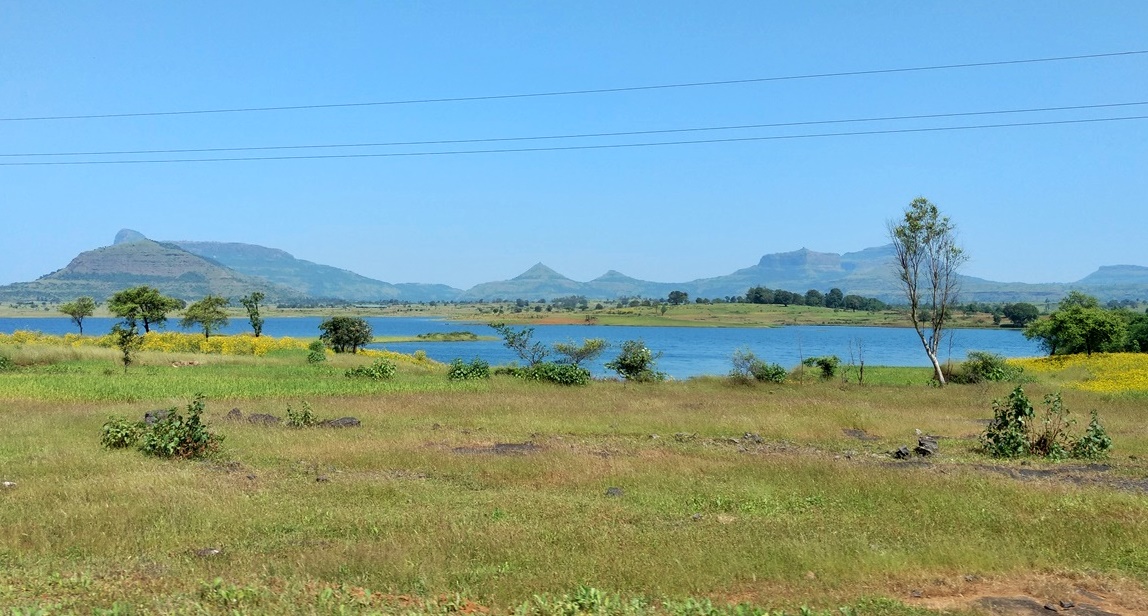
As expected, we cracked the deal for Rs1600 from Kasara to Nirgudpada and back. Finally we left at 10.00 am with an expected arrival of 12.00 pm. The route takes you via Khodala through the edges of Vaitarna reservoir. With rains just moved out, the sky being clear with little clouds, the green coat shined in the mid-morning sun with a yellow hue. It was very scenic. We halted at a couple of points for few selfies and reached our base village Nirgudpada at 11.45 am.

The banks of Vaitarna reservoir 

At Nirgudpada- Harihar killa in the background
Nirgudpada is a small sleepy hamlet with some 15-20 huts. A well-marked trail moves towards the fort soon after the village. Initial climb is through some over growth which provides adequate shade from the afternoon sun. I had bought a small plastic bag with me and while climbing I converted it into an eco-bag by putting whatever trash I found on the trail. It mainly included plastic wrappers and bottles. It was my bit to help clean the surroundings. After an hour of climb, we realised that it should take a little over an hour to reach the top. So we set a target time of 2 pm. The climb is just like any other trek till you reach the vertical rock patch that leads to the fort door. Just before that we found a local villager at a stall. We refreshed ourselves with lemon juice and proceeded towards the rock patch. I had read and seen many pictures about this one which appeared to be a little scary. So I kept my wallet and phone in my bag pack and tied my shoe laces tight just to gear up for the ascent.


Loved the way all minute details are captured in this macro shot.

Few more steps to enter the fort

The patch is around 150 feet high with steep steps carved in the rock. Adequate grip points are created to help trekkers climb with ease. Only important thing is to be careful while releasing your hand or leg to catch the next step. The total climb can be split up into two parts, the first 80 feet climb will take you till the entrance and the remaining 70 will take you to the top. After crossing this point the watch tower is about 20 mins away. Before the watch tower, there is a small Hanuman temple besides a fresh water pond. We relaxed here for a while before moving towards the watch tower. This spot is an excellent place for photography. The clam cold water of the pond offers spectacular reflection shots. After spending some time at the pond, we decided to eat lunch at the watch tower. Like any other summit, the view from the tower is spectacular. One can see the huge expanse of the Vaitarna reservoir from here.


That pristine lake to capture perfect reflection shots

This is the feeling I was talking about...
Reaching the summit gives me a feeling of victory. It makes me feel that I have fought the battle with the huge mountain and survived to tell the story. It is a different high to be on the top most point of a mountain and see the world beneath you. There are birds who sing the song of victory and the wind provides necessary background score. I never feel refreshed anywhere else as I do on the mountain top. My eyes continuously capture the beautiful frames of the wilderness around me.
Coming back to reality, it was time to head back to the base. We started our descend at 4.00 pm aiming to reach Nirgudpada by 6.00 pm. The descent is always fast and one can manage to come down in almost half time. The only tricky patch is the steps, which needs to be carefully covered. Once through we stop for one or two breaks just to click pictures or take a splash near the stream. As we near the village, we could see dozens of cattles moving back to their barns, farmers finishing off their days work and returning to their houses and kids playing around and singing songs.

This is how we ended that beautiful day
Our driver Yogesh was waiting for us at the exact same location where he had dropped us in the morning. A little tired and fully refreshed, we leave Nirgudpada just before sunset to head towards Kasara station. The return route took us right from the middle of Vaitarna reservoir. It was fantastic to see our vehicle moving on the road surrounded by huge expanse of water filled to the brim and the sun setting in the background. The cold winds made us close the windows but the dim light outside was heart-warming. Our jeep joined the Mumbai-Agra highway at Ghoti and within next 45 minute we were at Kasara railway platform taking a fast local to Dadar.