Monday, 13 March 2017

VT-EVB "Velha Goa"

Being a toddler I always used to admire the big double-decker plane flying over my head with 4 powerful roaring engines. As I grew up, I came to know that this flying creature is called as a jumbo jet or a Boeing 747. Since then I wanted to experience how it feels like to actually fly in this aircraft. Over the years many new airliners joined commercial aviation but my love for this particular species never diminished.

Her massive size, turbo charged looks and a hump on the head gives her a unique feel. One can easily distinguish a 747 from any other aircraft by looking at the twin decks. Since her inception, she has been the undisputed queen of the skies.  As demand for air travel increased in the late 1960s, there was a need to build bigger airplanes with more seats. The jet engine evolution made it possible for Boeing to build larger planes. A 747 usually fits around 400 passengers in a three class layout.

In India, only Air India currently uses a fleet of B747. They were delivered to the airline in early 90s. AI used to operate the jumbos on the long and ultra long haul routes to the US and Europe. Over the years, the fleet got old and it became economically difficult to operate these mammoth sized fuel guzzlers. Plus more energy efficient and greener alternatives became available in the market. Naturally, their usage drastically reduced in this millennium. Currently AI has a fleet of only 4 Boeing 747 aircrafts which they plan to retire sometime next year.

The idea of taking a ride in this aircraft was getting strong in my mind before it disappeared permanently. I began to keep a track of the routes on which they operate. After a small research, I short listed two routes BOM-HYD and BOM-DEL. Without wasting much time, I booked myself on AI965 to Hyderabad departing March 5th at 1500 hrs.

Terminal 2 interiors
I reached the airport a good 2 hours before the scheduled departure. After completing the check ins and security, I took a walk inside the beautifully built CSIA new terminal. The terminal design is so attractive that one cannot stop giving a second look. 

Terminal 2 interiors
After taking a few pictures of the terminal, I proceeded to my assigned gate 66. Boarding had already begun by the time I reached there. Excitement filled in when I got a first-hand look of this beauty; VT-EVB named “Velha Goa” waiting at the gates shining in the bright afternoon sunlight. This aircraft has been with Air India since Nov 1996. A small walk through the aerobridge and I put my foot in a 747 for the first time. The crew guided me to my seat 33A located in the front half of the plane. From my seat, I could see the 2 huge engines charging up for the flight. Once we received the mandatory clearances, we did a push back a little after 15.10 and sat on the tarmac for a quick engine check up run.


First look of my ride VT-EVB "Velha Goa" at Gate 66 of CSIA T2.


After a swift round of briefing and safety procedures, we lined up on runway 27 for departure. This aircraft had refurbished interiors with IFE fitted. Though it looked old, the cabin was clean and well maintained. Being a domestic sector, the flight entertainment wasn’t accessible. Just 15 mins into the flight, the crew started their meal service. This time it included 2 butterscotch cookies, a cheese sandwich and mango juice. Now here I was disappointed a bit. They could have atleast come up with a vegetable sandwich. But it was just a cheese slice wrapped between two sheets of white bread. A big let-down, would give 2 on 5 for the food.


Snacks served soon after take off. AI is known for its food but this time it was a let down.
Post finishing the meal, I took a round of the economy class cabin. Economy has a seating capacity of 385 and is spread across the lower deck behind the business class. The rear half of the plane was sparsely filled with less than 50% occupancy. On my way back had a word with the crew who were more than happy to allow me to take pictures of the cabin. This young lady asked me to climb the upper deck where she introduced me to one of her colleague. Even she was impressed to know I was travelling on this plane just to get a feel of it and asked me to email the pictures that I click for their training purpose.  

Economy class cabin. Seating 3-4-3

This way leads to the upper deck where the First class is seated
My seat 33A. Economy had an excellent legroom suitable for a long haul flight.

and this is how it looks when you climb up.
Upper deck first class cabin.

Business class cabin

Business class cabin

I was asked to come back after the flight to take seat facing shots. By the time I returned to my seat, we had already begun our descent into Hyderabad. After a series of turns we finally lined up for the runway and did a smooth landing at 16.28. Once all the passengers deboarded, I headed back to the business class cabin for the second session of photographs. The stewards there offered to click my pictures posing inside the business class cabin. It was a warm gesture from the crew. Their area of work is to take care of the passengers on the flight. But when some crazy nerd asks for a favour this is something that wins them brownie points. Overwhelmed by their hospitality, I deboarded the aircraft happy and completely satisfied.

My ratings for some key aspects on the flight:
Aircraft – 4/5
Punctuality – 5/5
Crew – 4.5/5
Food – 2/5

A view of our neighbourhood from the otherside.


Thursday, 27 October 2016

For the love of mountains...

I would like to be a cave man if life offers me such views every morning
A trek is always a stress buster for me. A week long fatigue vanishes in a single day of hiking. A trek to me is like a fight with the mountain. A fight to conquer something very huge, giant and massive. It gives me a feeling of accomplishment. It is a proof that I have fought and won a huge obstacle. Well that is why I trek. But apart from that trekking gives me adrenaline rush. I feel very much alive when I am on a trek. I get a chance to be one with mother nature. It is an opportunity to find your roots.

All said, it becomes very difficult to practically implement the pleasure of being one with nature in today's urban set up. But whenever possible, I plan out a trek with my buddies. This time it was Harihar. This trek aroused my interest when I first saw its pictures posted by a friend on Instagram. The pics looked intimidating. Steps carved between huge vertical rock surface leading to the fort entrance. The moment I saw that pic, this trek was on to my to-do list.

As usual, I did my quick homework about Harihar trek- the topography, location, mode of transport, terrain, things to carry and so on. These days it doesn’t take much effort on my part to plan for a single day trek. It is just like picking up my bag and taking a small city tour. So I managed to gather a group of four for this trek. All set, I was awaiting for the weekend to come. But there’s no excitement if everything goes as planned. The night before the trek, I received the first rejection. So now only 3 are left for the day. We planned to take the 7.08 am Kasara fast local from Dadar. It is 6.15 am in the morning and the second guy just refuses to pick up his phone. All 12-15 calls go waste. By 6.45 am, it was pretty much certain that this guy will not turn up. Me and my friend are the only two members for the trek.

We board the local but are uncertain whether we should do this trek. Reason being, the remoteness of it. We were not sure about the mode of transport to be taken after reaching Kasara. I was almost sure that there was no direct public transport available from Kasara to take us to the base village of Nirgudpada. So on our way to Kasara, we were trying to find out any other treks nearby which can be easily managed. We reached Kasara at 9.15 am. There were several share cabs outside the station but all were bound for Nasik. We were told that there are no ST buses to Nirgudpada from Kasara. Now, the only option with us was to hire a private jeep and that was a big deal.
A jeep for two would cost us over Rs.2000. After a few unsuccessful rounds of bargain, we were on the verge of giving up the idea of Harihar. Instead, my friend, Mihir found out a small trek called Tringalwadi somewhere near Igatpuri. So we were about the check for the mode of reaching there when a cab driver approached us for Rs 1800. We immediately realised that if we push him a little further, he may reduce more as both of us were in no mood to let this trek go.

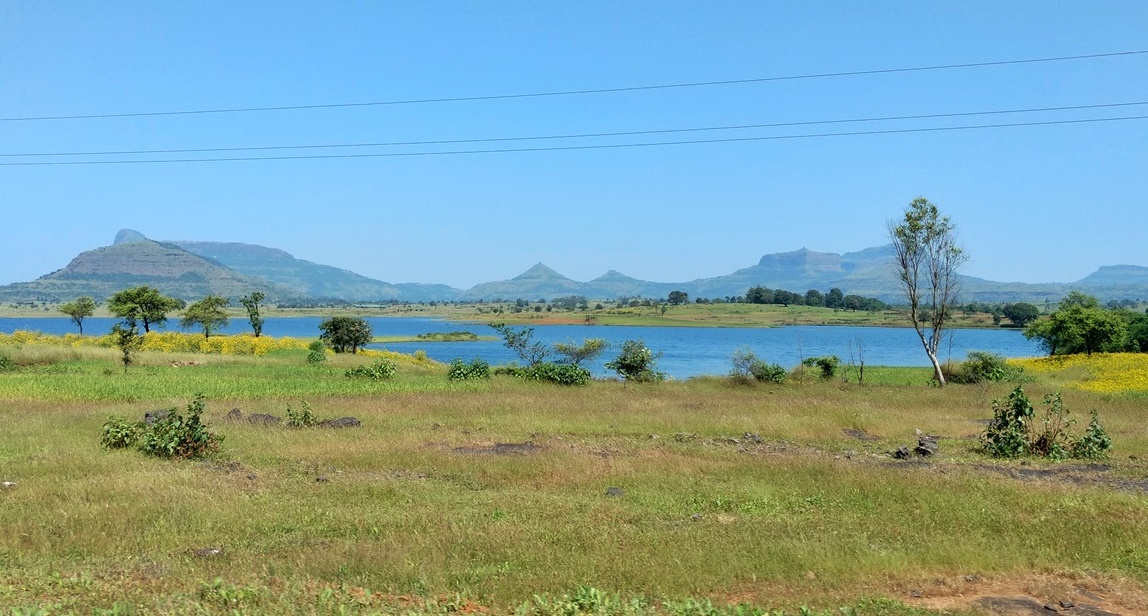
As expected, we cracked the deal for Rs1600 from Kasara to Nirgudpada and back. Finally we left at 10.00 am with an expected arrival of 12.00 pm. The route takes you via Khodala through the edges of Vaitarna reservoir. With rains just moved out, the sky being clear with little clouds, the green coat shined in the mid-morning sun with a yellow hue. It was very scenic. We halted at a couple of points for few selfies and reached our base village Nirgudpada at 11.45 am.

The banks of Vaitarna reservoir 

At Nirgudpada- Harihar killa in the background
Nirgudpada is a small sleepy hamlet with some 15-20 huts. A well-marked trail moves towards the fort soon after the village. Initial climb is through some over growth which provides adequate shade from the afternoon sun. I had bought a small plastic bag with me and while climbing I converted it into an eco-bag by putting whatever trash I found on the trail. It mainly included plastic wrappers and bottles. It was my bit to help clean the surroundings. After an hour of climb, we realised that it should take a little over an hour to reach the top. So we set a target time of 2 pm. The climb is just like any other trek till you reach the vertical rock patch that leads to the fort door. Just before that we found a local villager at a stall. We refreshed ourselves with lemon juice and proceeded towards the rock patch. I had read and seen many pictures about this one which appeared to be a little scary. So I kept my wallet and phone in my bag pack and tied my shoe laces tight just to gear up for the ascent.


Loved the way all minute details are captured in this macro shot.

Few more steps to enter the fort

The patch is around 150 feet high with steep steps carved in the rock. Adequate grip points are created to help trekkers climb with ease. Only important thing is to be careful while releasing your hand or leg to catch the next step. The total climb can be split up into two parts, the first 80 feet climb will take you till the entrance and the remaining 70 will take you to the top. After crossing this point the watch tower is about 20 mins away. Before the watch tower, there is a small Hanuman temple besides a fresh water pond. We relaxed here for a while before moving towards the watch tower. This spot is an excellent place for photography. The clam cold water of the pond offers spectacular reflection shots. After spending some time at the pond, we decided to eat lunch at the watch tower. Like any other summit, the view from the tower is spectacular. One can see the huge expanse of the Vaitarna reservoir from here.


That pristine lake to capture perfect reflection shots

This is the feeling I was talking about...
Reaching the summit gives me a feeling of victory. It makes me feel that I have fought the battle with the huge mountain and survived to tell the story. It is a different high to be on the top most point of a mountain and see the world beneath you. There are birds who sing the song of victory and the wind provides necessary background score. I never feel refreshed anywhere else as I do on the mountain top. My eyes continuously capture the beautiful frames of the wilderness around me.
Coming back to reality, it was time to head back to the base. We started our descend at 4.00 pm aiming to reach Nirgudpada by 6.00 pm. The descent is always fast and one can manage to come down in almost half time. The only tricky patch is the steps, which needs to be carefully covered. Once through we stop for one or two breaks just to click pictures or take a splash near the stream. As we near the village, we could see dozens of cattles moving back to their barns, farmers finishing off their days work and returning to their houses and kids playing around and singing songs.

This is how we ended that beautiful day
Our driver Yogesh was waiting for us at the exact same location where he had dropped us in the morning. A little tired and fully refreshed, we leave Nirgudpada just before sunset to head towards Kasara station. The return route took us right from the middle of Vaitarna reservoir. It was fantastic to see our vehicle moving on the road surrounded by huge expanse of water filled to the brim and the sun setting in the background. The cold winds made us close the windows but the dim light outside was heart-warming. Our jeep joined the Mumbai-Agra highway at Ghoti and within next 45 minute we were at Kasara railway platform taking a fast local to Dadar.


Sunday, 15 November 2015

Trek after a long break

After a break of nearly one and a half year we finally planned for a trek, this time it was Siddhagad. One day because of time contrainst that we city dwellers always have. Neeraj(aka Raja), Santosh(aka Santy), Himanshu( aka Joshi) and myself were the members for this trek.
Siddhagad is hill fort situated in Thane district and one hour drive from Murbad. It is surrounded by Gorakhgad and Bhimashankar and lies in Bhimashankar wildlife reserve. So be sure the trek moves through dense vegetation and overgrowth.
The route to the base village 
We met at Dadar station(CR) pf.4 at 07.15 am and took Badlapur Fast to Kalyan. Being a long weekend and a Saturday, the train was comparatively less crowded. It took us to Kalyan by 8.25 am. After alighting there, we proceeded to a restaurant to have a quick breakfast. I had Idli chutney while the other three had Missal Pav. Kalyan ST depot is just outside the railway station on the west side. We were lucky this time that we got a Murbad bound ST bus. Again very sparsely crowded. There are frequent buses available for Murbad. So the waiting time is very less at Kalyan depot. It takes exactly an hour to reach Murbad depot. We reached there at 10.30 am. Now, there are two options available to reach Narivali, the base village. One is the ST shuttle service to Narivali-Dehri and the other is share taxi/ jeep. We were told that the bus to Narivali will leave only after 11 am, so we opted for the share taxi. These guys take you to Mhasa, around 12 km from Murbad. From there a second share cab to Narivali( ~5 km). They charge you around 15-20 bucks per seat. Around 18 people are squeezed into that vehicle for a bumpy ride. It takes further 45 min to 1 hr from Murbad to reach Narivali.

Siddhagad head on

Just ask any local for your heading and you will be on your path to Siddhagad. To the left you can see Gorakhgad mountain and to your right is Siddhagad. The initial path moves between these two peaks for about 2 kms after which it starts climbing after crossing a village. Again just ask for directions just to make sure you are on the right path. There is a very less chance of meeting any local after crossing the village, so need to be careful with the path. There are multiple trails which split and join you. So it is easy to lose track, which exactly happened to us. Around 30 mins into the trek we found ourselves at a small stream soon realising that this cannot be the way up. So after cooling ourselves at the waters we again retraced the route to a cross road. Moving forward for another half an hour we were at the centre of a dried up water path. Though we knew this wasn’t the way up, it was a very pleasant spot to relax. So we decided to have our lunch here. Our lunch included chutney sandwich, cucumber, khichdi and chakli. There we met a lone trekker who was also looking for the right path like us. The place was so relaxing that few of us were in no mood to proceed further. After debating on that for a while, we decided to keep searching for the right trail and move further. So retracing back a little, we soon found a cross road and a arrow guiding this way up!
(L-R) Neeraj, Joshi, Santy and yours truely
On the way to Siddhagad machi

The arrow is always a welcome sign. Infact the route is well guided with arrows. So if you don’t see one, be sure that you have missed out something. From here, it was an hour climb to the ancient fort door. The walk is well routed but very exhausting. The old structure offers you a good background for some selfies. Himanshu was too tired to move further to the village of Siddhagad machi. His constant blabbers were completely ignored by us. So he didn’t have much of an option but to keep walking :P
The entrance door

It is a 15 min plain walk to the village of Siddhagad machi from the darwaja. This was our pitstop for today. We must have reached there by 4 pm, refilled our water bottles and after a small chit chat with the local boys again started our return jouney. They say an hour or so of rock climbing from Siddhagad machi leads to the fort. But looking at the huge mountain behind we didn’t think it was a good idea to take that climb, may be next time if we come.
The decent is pretty fast as the probability of losing track is almost nil. The total descend time must be around one and a half hour with occasional ‘selfie’ halts. We crossed the base village around 6.15 pm. It was almost dark by then. So we decided to have a small snack break in one of the small dry paddy field enroute. From there it was an uneventful 30 min walk in the dark to the access road. At the bus stop, we got a direct service to Murbad and from there to Kalyan. Took 9.08 CST fast and concluded our one day trek at Dadar, completely exhausted and fully refreshed.

                                             Here are some snaps...


Time line for the trek.

Dadar stn 07.15
Kalyan 08.25
Left for Murbad 09.30
Reached Murbad 10.30
Share jeep to Narivali via Mhasa 11.40
Crossed base village 12.15
Lost our way 1st time at 13.00
Retraced back to the dry water stream 14.00
Lunch and rest till 14.45
Got back on the route by 15.00
Reached Siddhagad machi 16.00
Descend started 16.30
Crossed base village 18.05
Snack break till 18.30
Bus stop 19.00
Murbad 20.00
Kalyan 21.00
Dadar 22.00
Home 22.15

--The End--

Thursday, 23 October 2014

Wild flowers of Kaas


Visit to 'Kaas pathar' was on my to do list since long. But one needs to visit this place only in September to see the bloom.  Got a chance this season and decided to take a roadtrip to Kaas.
It’s a place where every nature lover and a photographer would find solace. Kaas plateau located approximately 25 km from Satara town and 267 km from Mumbai. Every year during the month of September this place blooms with multitude of Jambhali chirayat, Sonakee,Nisurdi ,Kavala etc to name a few.This road trip to the beautiful landscape and also covers the famous Thoseghar waterfall (25 km from Satara) and Chalkewadi windmill farm.
A 6 hr drive from Mumbai took us to Satara, from there proceeded towards Thoseghar and Chalkewadi. The first set of pictures belong to this place.
Express highway @ Foodmall Lonawala
@ Chalkewadi. It has become a major tourist attraction because of the scenic views that it offers. 
A random flower on the roadside
This is a small waterfall on the uphill

My Car parked next to a giant windmill

Crowd taking a look of Thoseghar waterfall. Aviewing gallery has been built for the same.
One has to walk for 15-20 min from the car parking area to reach this place.

Panorama view of Urmodi reservoir on the way to Kaas
Outskirts of Satara moving uphill to Kaas

Now presenting the hall of fame images.
Flower Scape
Flower Scape

Lal Terda scattering all over

Three trails are marked at Kaas for tourists to follow. This image is taken on Trail 1.
Impatiens oppositifolia (Marathi- Lal Terda)


Biological name - 'Cyanotis tuberosa'
(Marathi - Nabhali )
Name - 'Pogostemon deccanensis'( Marathi- Jambhli Manjiri)
Biological name - 'Drosera indica'
(Marathi : Gavati Davbindu)

This is an insectivorous plant.As seen here in the photograph,the tips of the tentacles are formed by sparkling dots of sticky liquid. Those are not dew drops but sticky glue like structure to which once the insect sticks, it can't escape.

A bug resting on leaf of 'Mpatiens Oppositifolia'


A random shrub on the ground


Thorny leaves of impatiens oppositifolia


'Senecio Grahamii'
A butterfly sucking nectar from the flowers of Paracaryopsis Coelestina / Common Hill Borage

 (Marathi : Nisurdi)

Flower name - 'Murdannia lanuginosa' (Marathi- Abolima)
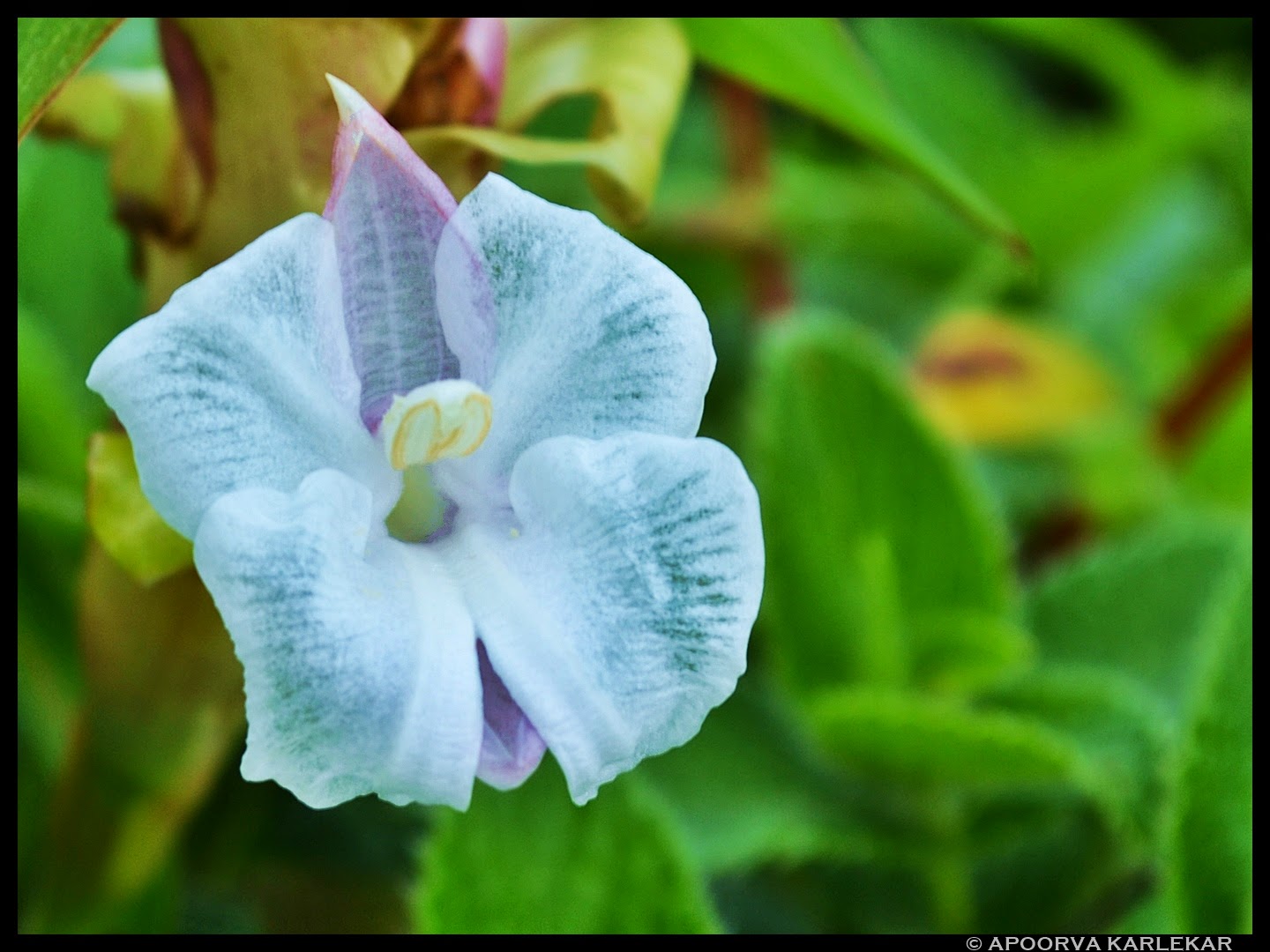
Hitchenia caulina (local name Chavar)
Morning Glory
Zoomed to see the pollen grains
Name - 'Utricularia Purpurascens' (Marathi- Seeteche Asawee)
Name - 'Utricularia Purpurascens'

Biological name - 'Eriocaulon tuberiferum' 
(Marathi : Pangend)
This small ball-shaped, aquatic herb has this 6-7mm diameter ball on top.
Vigna Vexillata or "Elephant's trunk" 
(Marathi : Halunda)
Biological name - 'Strobilathes sessilis'
(Marathi - Topali Karvi)

Biological name - 'Hitchenia Caulina' 
Common name is 'Indian Arrowroot'

'Senecio Grahamii'

A 'Tetli-Satara' local bus service proceeding towards Satara.

Every nature lover must make it a point to visit this place during the bloom season. It also called 'Valley of flowers' of Western India.